 Aviator
 Cat-eye
 Square
 Oval
 Rectangular
 Round
Screwless, Flexible, Hidden Spring: Choosing the Right Hinge System for Your Frame Program
Hinges rarely appear in a buyer's first brief — they show up later, in the warranty report, as the single most common mechanical claim on optical frames. And because a hinge sits where a frame's stresses concentrate, its construction quietly sets the ceiling on how durable any front design can be. This article compares the three hinge systems a frame buyer meets in OEM production — standard barrel, hidden spring and screwless flexible — and lists the factory-side tests worth writing into your next tech pack.
What a Hinge Actually Does
A hinge has three jobs: join front to temple, hold the open angle against daily handling, and fold without chewing up the acetate around it. Every field failure — loose feel, cracked seats, snapped rivets, worn springs — traces back to one of those jobs not being engineered for real use. Material matters, but system choice matters more, because it decides where the flex lives.
Three Hinge Systems Compared: Barrel, Hidden Spring, Screwless
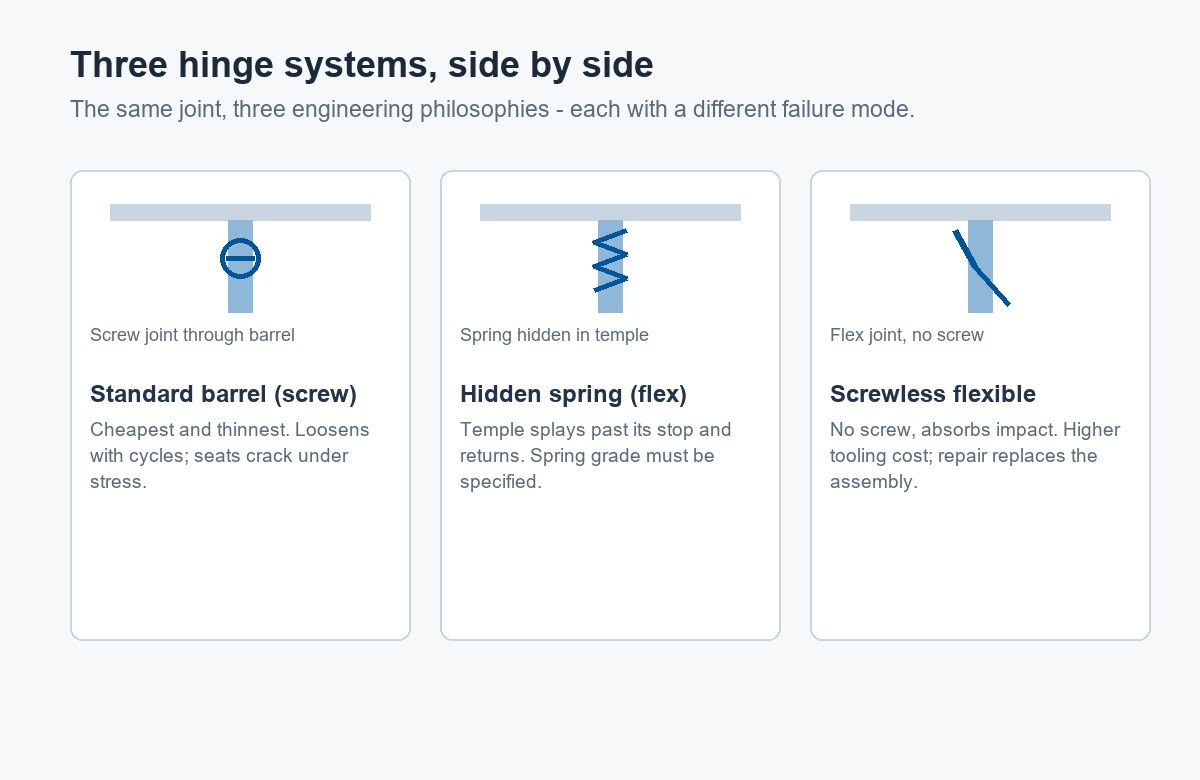
| Standard barrel (screw) | A riveted or screwed barrel hinge set into the front. Cheapest and thinnest; no flex beyond the screw joint. Failure mode: seats loosen with cycles, acetate around the barrel cracks under repeated stress. Fine for reading glasses and low-rotation designs. |
|---|---|
| Hidden spring (flex) | A spring-loaded hinge concealed inside the temple, letting the temple splay past its stop and return. The industry's default for premium acetate: the flex absorbs the over-opening that breaks barrel hinges. Failure mode: spring fatigue if the spring steel is under-specified — which is why spring wire grade, not just brand name, should be specified. |
| Screwless flexible | Monolithic or multi-part flexible joints with no screw at all — the system that carried this year's SILMO d'Or craftsmanship winner. Excels at impact absorption and eliminates the screw as a loose part. Trade-offs: higher tooling cost, design constraints on temple thickness, and repair usually means replacing the assembly rather than tightening a screw. |
None of the three is universally "best". A reading glass that folds twice a week does not need a spring; a kids' frame that will be slept in does. The common buyer error is defaulting to the cheapest system across all SKUs instead of matching system to use case.
What the Award Season Signals
The cost model is straightforward: if hinge-related claims run at 3–5% on barrel-hinge programs and drop below 1% on well-sprung ones, the per-unit premium of a quality hidden spring is recovered many times over on a 1,000-pair programme — before counting the brand damage of a frame that fails in month two.
Six Hinge QC Tests for Eyewear Buyers
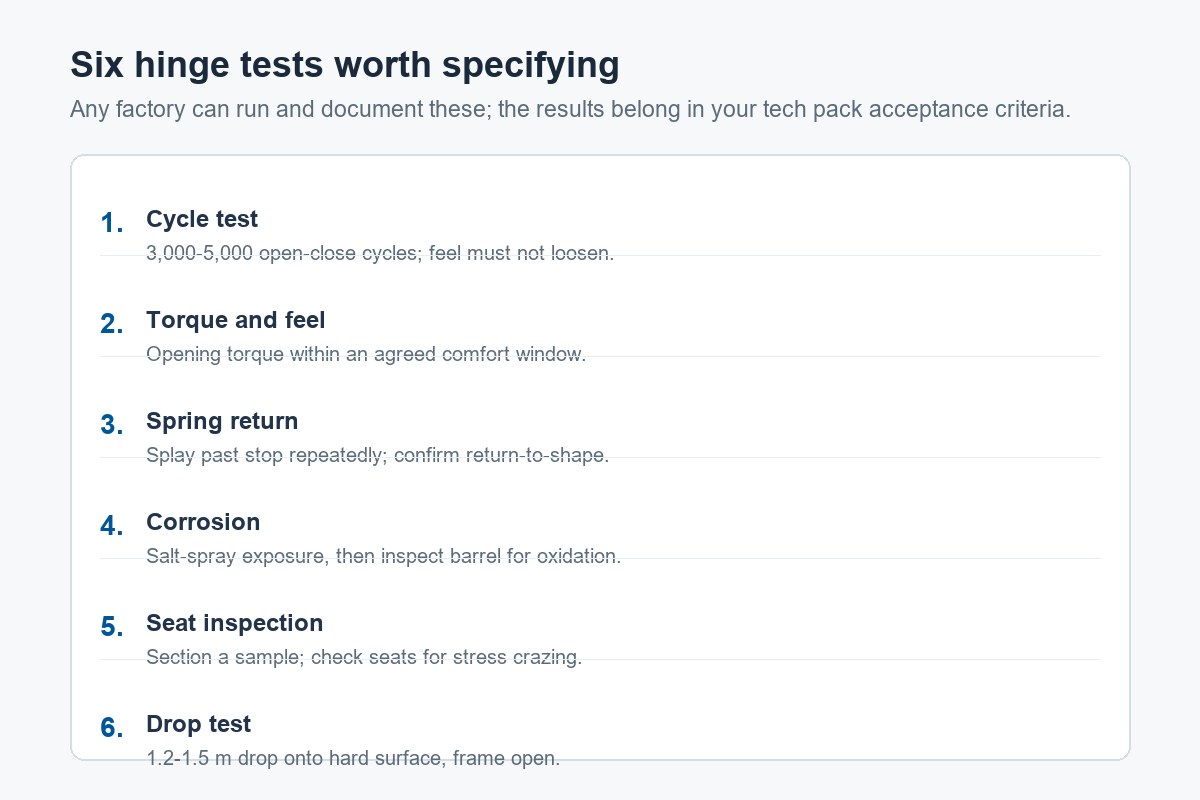
- Cycle test. 3,000–5,000 open-close cycles with feel recorded at intervals; the feel should not loosen measurably.
- Torque and feel. Opening/closing torque within an agreed window — loose enough for comfort, firm enough to hold position.
- Spring return. For flex systems: splay the temple past its stop a fixed number of times and confirm return-to-shape within tolerance.
- Corrosion. Salt-spray exposure for plated hinges, then check for oxidation at the barrel.
- Seat inspection. Section a sample frame and inspect the hinge seat area for stress crazing under magnification.
- Drop test. A 1.2–1.5 m drop onto a hard surface, frame open — the closest simulation of daily life a lab can offer.
Writing Hinge Specs into Your Tech Pack
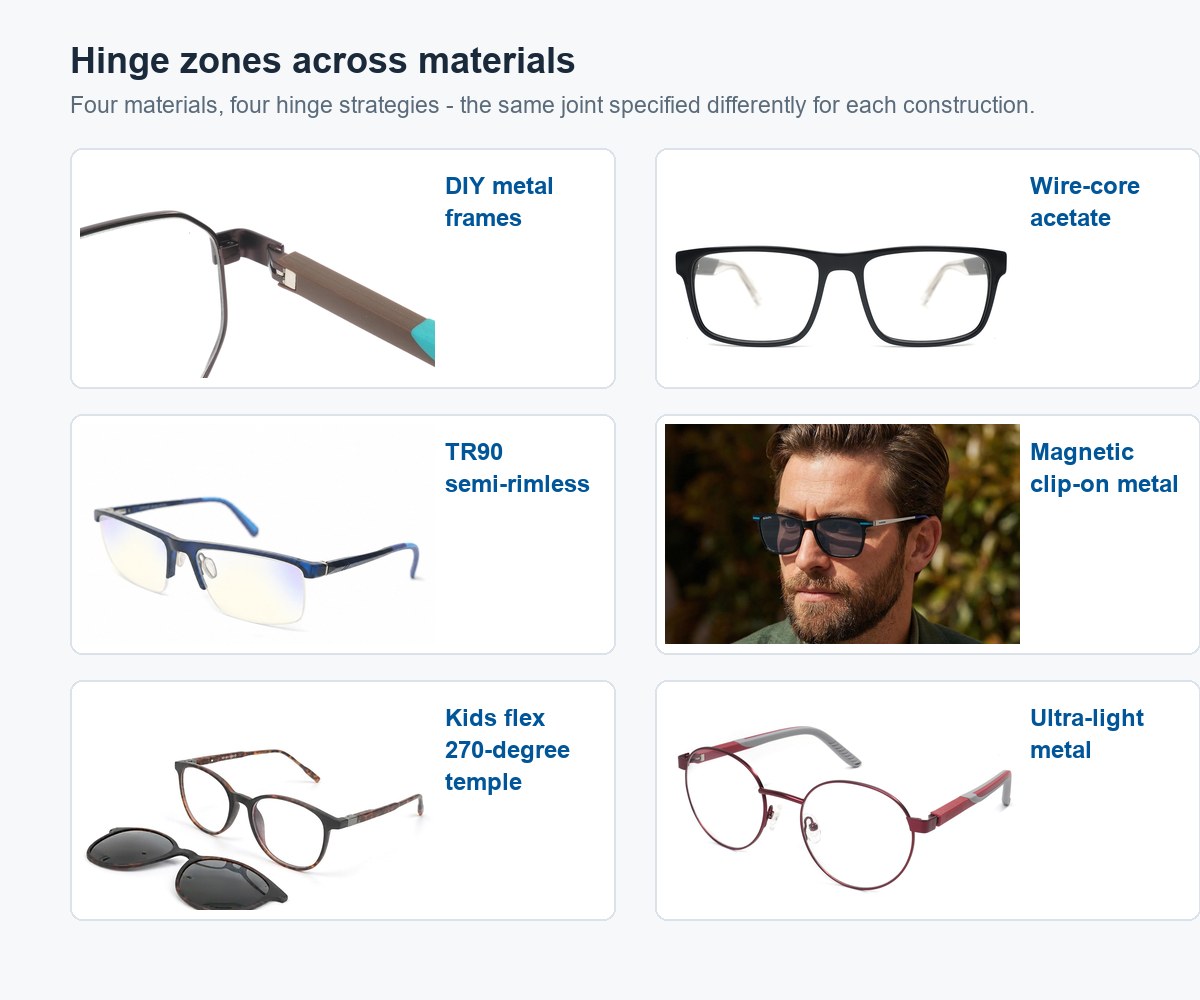
A hinge line in a tech pack should name the system, the spring wire grade where applicable, plating, cycle-count requirement and the acceptance feel. If a supplier cannot answer those five lines, the hinge is whatever arrived cheapest that week. For the adjacent decisions, our material cost and performance matrix and the hidden spring specification guide cover both sides in depth.
READSUN specifies hinge systems per SKU with documented cycle testing on acetate, clip-on, kids' and titanium programs. Send a tech pack through the inquiry form and we will return a hinge recommendation with test evidence and tooling notes.