 Aviator
 Cat-eye
 Square
 Oval
 Rectangular
 Round
SILMO d'Or 2026: The Craft Details Behind This Year's Winning Frames
We stood on stand Hall 6 D085 at SILMO Paris this September, and the conversations at our booth surprised us: buyers asked less about colours and more about hinge construction, sheet traceability and how a kids' line survives a playground. A day later the SILMO d'Or jury confirmed the same instincts — this year's highest honours went to engineering, not decoration.
What Won at SILMO d'Or 2026
SILMO Paris 2026 drew 32,108 professional buyers — 53% of them international — past more than 950 exhibitors. But the clearest signal for OEM buyers came from the craftsmanship categories of the d'Or, where material and mechanical choices carried the day. Three winners are worth studying.
Three Winning Frames Worth Studying
Rolf SUPERBIRD: Stone, Wood and a Screwless Hinge
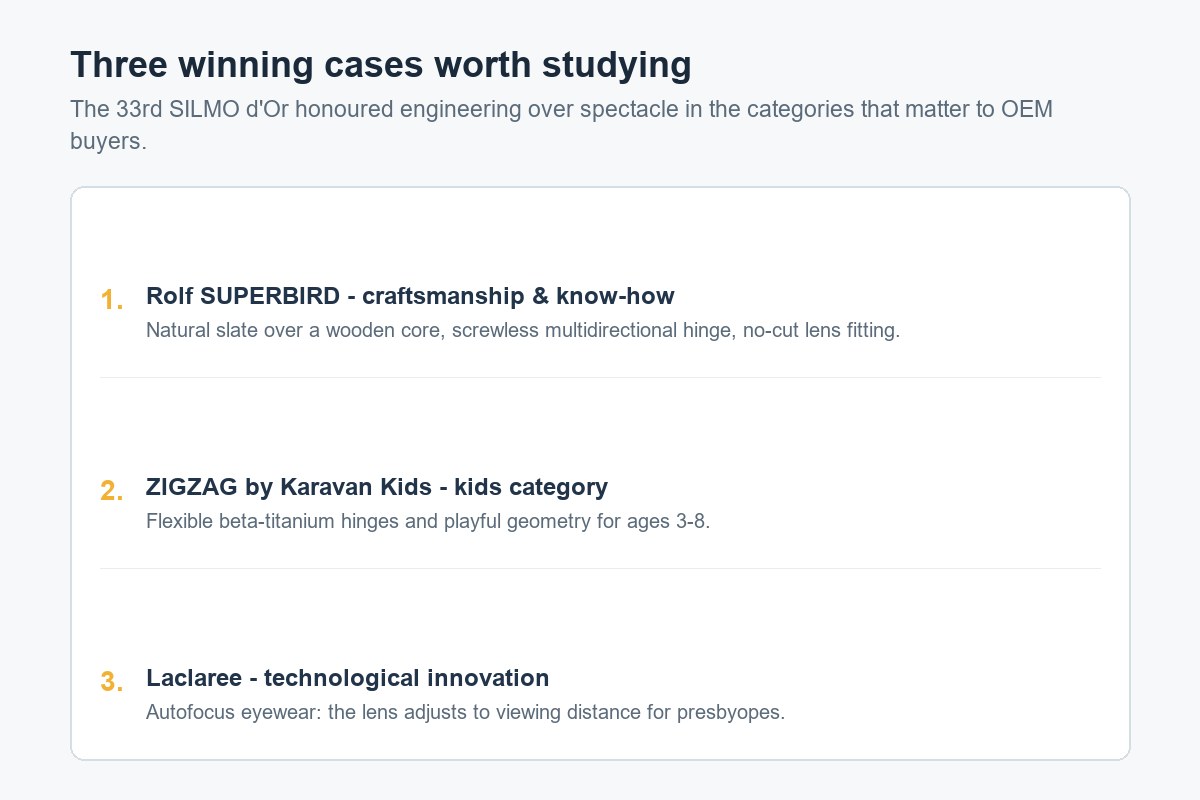
The craftsmanship and know-how award went to Austria's Rolf for a frame faced with ultra-thin layers of genuine slate over a wooden core — every frame unique by construction. The instructive part is not the stone. Rolf solved the two most common warranty drivers by redesigning the joints: a threaded lens fitting that never cuts the front, so the stone pattern runs unbroken, and a screwless flexible hinge that absorbs impact instead of passing it to the rim.
ZIGZAG: Beta-Titanium Built for Small Wearers
The kids' category went to a 3–8 age frame built around flexible beta-titanium hinges. Children bend, drop and sleep on their glasses; the winning answer moved the flex out of the rigid front and into the hinge zone, where the titanium springs back instead of fatiguing. Fun on the shelf, survives the schoolyard — the combination retailers struggle to find, and one our children's eyewear buyer's guide covers in depth.
Laclarée: The Frame That Adjusts Itself
The technology award went to France's Laclarée for autofocus eyewear aimed at wearers over 45: instead of hunting for the sweet spot in a fixed progressive corridor, the lens system adjusts focus to viewing distance. "Wearer-adaptive" is moving from marketing language into mechanism.
What the Winners Signal for 2027 Eyewear Programs
- Material storytelling must be verifiable. Stone, wood and bio-based acetate win juries because the material story survives scrutiny. Expect the same of suppliers: sheet tier, batch traceability and finish process, documented.
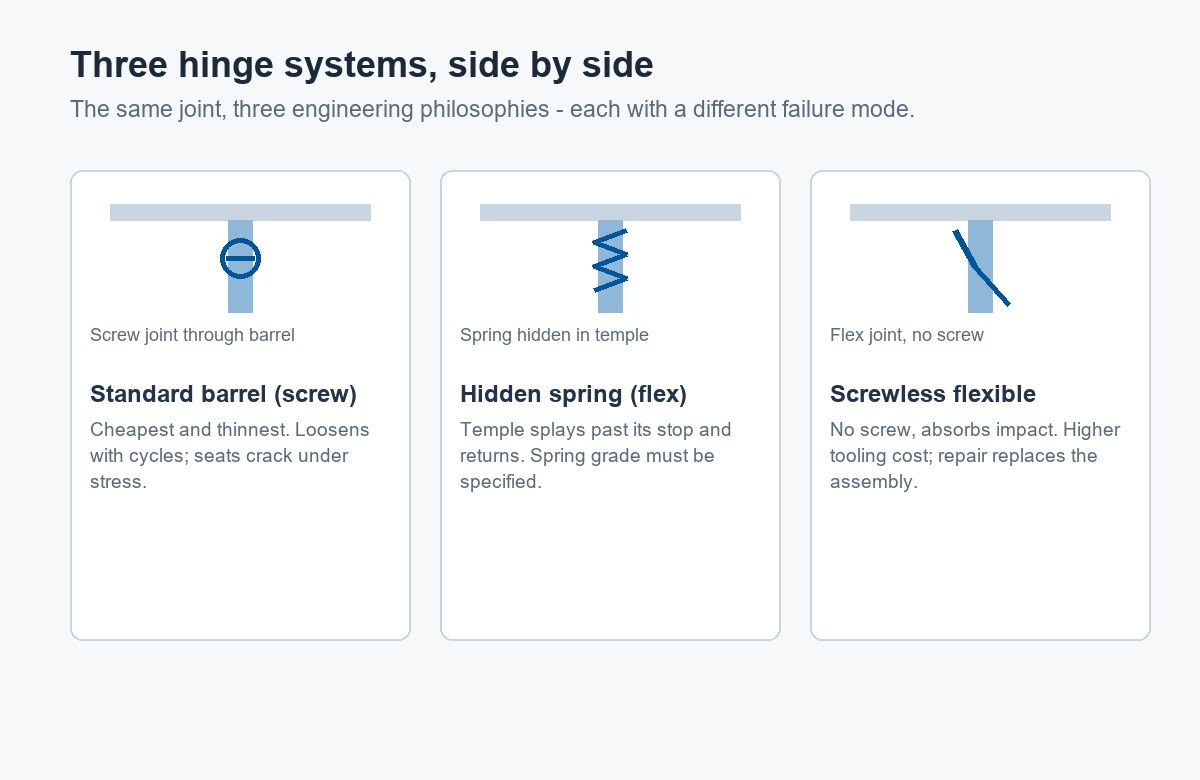
- Hinge engineering is a differentiator, not a commodity. Two of this year's standouts treat the hinge as the design problem. Hidden-spring and flexible systems cost more per unit than a barrel hinge — our hinge specification guide walks the trade-offs — and earn it back in returns avoided.
- Adapt and protect, don't just decorate. A kids' hinge that survives a playground, a lens stack that adjusts itself: the winning direction is frames that respond to the wearer. Brief cycle counts, drop tests and return-to-shape alongside colour.
How to Brief Your Eyewear Supplier
Awards only matter if they change specifications. For a 2027 program: ask your supplier to name the sheet tier and show batch records; write hinge type and cycle-test numbers into the tech pack instead of "good quality hinge"; require return-to-shape tests on kids' temple assemblies, not just pull tests on the hinge pin. None of these add much cost at the specification stage — all of them are expensive to discover missing after the container lands.
Our team reviews briefs like these every week — send yours through the inquiry form and we will return a line-by-line factory response with tooling and sampling timelines.
SILMO at 60 in 2027
The next SILMO Paris marks the show's 60th anniversary and runs 25–28 September 2027 — the industry's most concentrated European audience. We expect to be on the floor again, and we expect the craftsmanship categories to keep rewarding exactly this kind of engineering.