 Aviator
 Cat-eye
 Square
 Oval
 Rectangular
 Round


Years of industry experience

Designed to Reflect You
Global Eyewear Brands’ First Choice in Manufacturing
Home / All / Custom Optical Frame / Custom Men Optical Frame / Custom Wooden Texture Bio-Acetate Optical Frame
Custom Wooden Texture Bio-Acetate Optical Frame


Detail Information
A second wood-grain bio-acetate shape, offered so a buyer can build a small natural-materials collection around one material specification.
Overview
Bio-acetate is cellulose acetate whose plasticiser is sourced from plant material instead of fossil feedstock, and the reason to use it is practical rather than decorative: more retail buyers now need a frame material they can describe honestly in a sustainability note. This front is cut from bio-acetate sheet and finished with a wood-grain effect, so the frame carries the warmth of timber without the moisture sensitivity of a real wood veneer. Grain direction is the variable that separates the two shapes: a horizontal run reads calmer on a wide rim, a vertical run reads more architectural.
The grain is created in the sheet and protected by the polishing stage rather than painted on afterwards, so it survives cleaning with a microfibre cloth and does not lift at the rim edge. Because the base material behaves like conventional acetate, the frame can still be reamed, heat-adjusted and repaired with the tools an optical workshop already owns. The base sheet behaves like standard acetate on the bench, so a laboratory does not need new equipment to glaze or adjust the frame. For a brand building a natural-materials story, that combination is easier to support than a laminate that separates after a season of wear.
Key Features
Plant-Based Acetate Sheet
The sheet uses a bio-derived plasticiser, which lowers the fossil content of the finished frame without changing how the material behaves on the bench. It reams, polishes and heat-adjusts like standard acetate, so a laboratory does not need new equipment to glaze it.
Wood-Grain Surface
Grain is produced during sheet making, then revealed by tumbling and polishing. Because the pattern sits below the surface rather than on top of it, cleaning and daily friction do not wear it away, and the rim edge shows a continuous line instead of a painted stripe.
Comfort and Balance
Rim thickness is kept moderate so the front does not dominate the face, and temple length is set to keep the frame balanced behind the ear. A demo lens is fitted at production, which holds the front in shape during transit and lets the buyer's lab swap lenses without reworking the groove.
Natural Colour Palette
Colours are built around wood, horn and stone references, with Any colour, matched to a swatch in the standard line and custom matching against a physical swatch. Logo can be hot stamped into the temple, laser marked for a quieter look, or applied as a small metal plaque on the outer arm.
Product Showcase
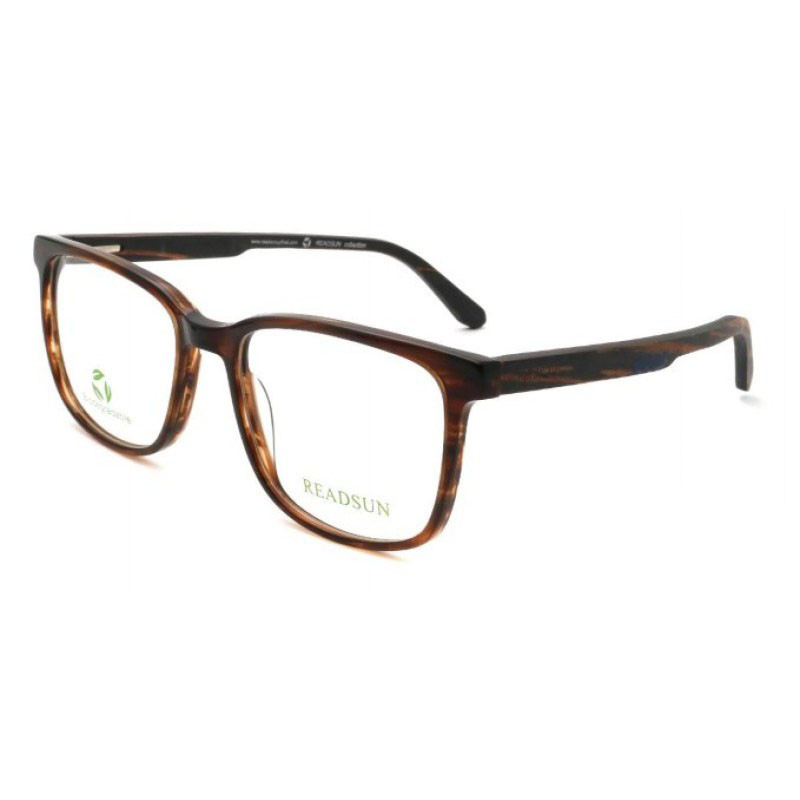
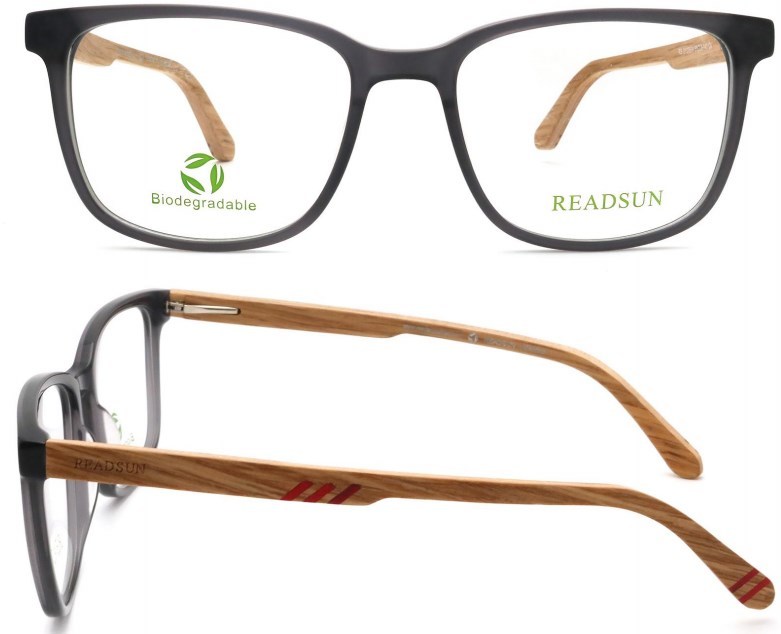
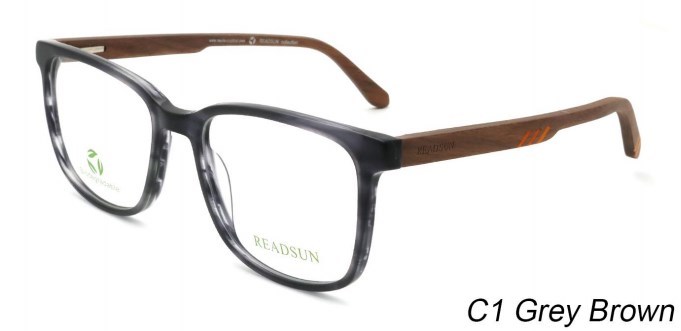

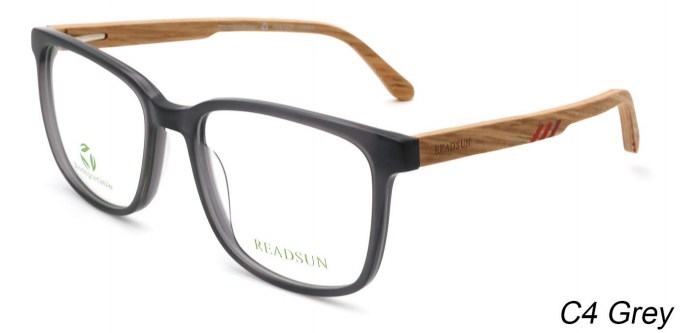
Views show the 21C067A sample and, where noted, a sister model from the same range, so the hinge position and temple profile can be compared before a sample is ordered.
Specifications
| Model No. | 21C067A |
|---|---|
| Category | Custom Men Optical Frame |
| Frame Material | Bio-acetate |
| Lens | Demo lens fitted at production |
| Sheet | Bio-based acetate with wood-grain effect |
| Temple | Metal temple with acetate tip |
| Size | Fixed by the mould, confirmed on the approved drawing |
| Colour | Any colour, matched to a swatch |
| Customization | Logo, colour, temple, lens and packaging; artwork approved from a proof |
| MOQ | 300 pcs per model |
| Certification | CE and FDA |
| Lead Time | 7 days after order confirmation |
| Payment Terms | T/T, 30 percent deposit and 70 percent balance before shipment |
| Port | Shanghai / Ningbo |
The values above come from the current specification sheet for this model. A size marked as fixed by the mould cannot be changed without new tooling, while colour, logo, lens and packing remain adjustable within the stated minimum.
OEM & ODM Customization
A wooden texture finish is created during sheet making, so the grain sits below the surface and survives cleaning. The bio-acetate base behaves like standard acetate on the bench, the acetate optical frame is reamed by hand for an accurate lens seat, and every wooden texture bio-acetate front is checked for grain direction before the optical frame is packed.
Bio-acetate projects usually begin with a material question rather than a shape question, so the first sample is as much about proving the surface as proving the fit. We produce a colour and grain chip set before the frame sample, which lets a buyer approve the look on a small piece instead of waiting for a full front. From there the project follows the normal path: temple, hinge, logo, packaging, documentation.
- Material grade: bio-acetate sheet is specified by colour, grain direction and thickness, and the grade is recorded on the specification sheet for repeat orders.
- Grain direction: the pattern can run horizontally or vertically across the front, which changes the character of the frame noticeably on a wide rim.
- Colour matching: wood, horn and translucent tones are matched to a physical chip, since screen rendering of natural patterns is unreliable.
- Logo application: hot stamp and laser both work on bio-acetate, but the depth of the mark is adjusted to the grain so the pattern is not flattened.
- Packaging: recycled board boxes, paper pouches and soy-ink printing can be specified when the retail story requires a matching pack.
- Sustainability file: material origin and bio-content documentation are supplied with the CE and FDA paperwork for buyers who need it for tenders.
Buyers who want the wider picture can review the OEM and ODM optical frames programme, which explains how tooling, sampling and documentation are handled across models.
Manufacturing & Quality Control
Production is organised around four checkpoints, and a frame cannot move to the next stage until the previous one is signed off. The process below is the same for a sample order and for a repeat run.
1. Sheet and Grain Inspection
Bio-acetate sheet is checked for thickness, grain consistency and colour variation between batches, because natural patterns shift more than solid colours. Sheets that fall outside the approved chip are held back before cutting.
2. Cutting and Forming
Fronts are milled to the drawing, then tumbled in graduated media to open the grain without blurring it. Bridge and end pieces are reamed by hand so the lens seat stays accurate on every frame.
3. Polishing and Surface Review
Polishing is done in stages with decreasing abrasive size, and each frame is reviewed under daylight-balanced light for grain continuity, colour depth and edge finish. Any frame with a visible polishing mark is reworked rather than passed.
4. Packing and Final Audit
Frames are sleeved, counted and sampled from each carton for grain direction, logo depth and colour match against the approved chip. Carton marks and the packing list are verified before the shipment is released.
Inspection records are kept against the model number, so a question raised months after shipment can be traced back to the batch, the operator and the material lot. The full procedure is described under quality control.
Applications
- Optical boutiques with a natural-materials positioning
- Sustainable eyewear labels that publish material sourcing
- Gift and lifestyle retailers buying small seasonal drops
- Distributors adding a premium tier above standard acetate
- Corporate programmes that specify reduced fossil content
- Export buyers sourcing a story-led frame for trade fairs
The bio-acetate line is part of the wider custom men optical frame programme and is also listed with the sustainable frames range, where material and packaging options are described together.
FAQ
Is bio-acetate the same as biodegradable plastic?
No. Bio-acetate changes the source of the plasticiser; it is not a compostable material and should not be described that way in retail copy. What it offers is a lower fossil content with the same workshop behaviour as acetate, and the documentation states exactly which claim is supported.
What is the minimum order for a grain or colour change?
MOQ for this model is 300 pieces. A change of grain direction or colour inside that quantity is handled as a normal production order, while a new front shape is a tooling project. Per-colour minimums are confirmed at quotation stage.
Can I see the surface before committing to production?
Yes. A chip set showing the grain and colour on the actual sheet is prepared before the frame sample, so the surface is approved on material rather than on a screen image.
Start Your Custom Order
Send the target colour family, the grain direction you prefer and the quantity, and the reply includes the chip set plan, FOB price, MOQ and the documentation package available for your market.
Prefer to compare shapes first? The custom men optical frame page lists the rest of the range.
Related Products
Build Your Private Label Eyewear Collection
- *Name
- *Phone
- *Title
- *Content
Why Choose READSUN as Your Optical Frame Manufacturing Partner
New products annually
Countries Exported Products
International Leading Brands Collaborated
Customer Satisfaction
Testimonials
Trusted by Partners Around the World












Products
Ability
