How to Choose a Reliable Sunglasses Supplier for Your Retail Business
Jun 26,2025
How to Choose a Reliable Sunglasses Supplier for Your Retail Business
Choosing the right sunglasses supplier is one of the most consequential decisions a retail buyer makes. Get it right, and you have a partner who delivers consistent quality, competitive pricing, and on-time shipments for years. Get it wrong, and you face defective stock, missed seasons, and damaged customer trust.
This guide covers the seven evaluation criteria that matter most when vetting a sunglasses manufacturer—from verifying factory authenticity to negotiating payment terms that protect your capital. At READSUN Optical, we have manufactured eyewear for B2B partners across 80+ countries for over 20 years. Here is what we have learned about what separates reliable suppliers from risky ones.
Criterion 1: Verify They Are a Real Factory, Not a Trading Company
The first question to ask any potential supplier is deceptively simple: are you a factory or a trading company? Both can be legitimate business partners, but they serve different purposes. A factory controls production directly, which means better quality oversight, lower pricing, and more flexibility on customization. A trading company adds a middle layer between you and the production floor.
How to verify:
Request a live video tour of the production floor. A real factory can show you machines in operation, not just a showroom.
Ask for the serial numbers of their testing equipment and verify calibration certificates. A capable factory will have this documentation ready[reference:0].
Check business registration documents. The legal entity should match the factory address, not a residential or virtual office.
Cross-reference the supplier's name against third-party audit databases. Certifications like BSCI are searchable by ID online[reference:1].
A factory that cannot clearly explain its production flow—or cannot say where plating, lens coating, or assembly happens—is a red flag[reference:2].
Criterion 2: Evaluate Technical Capability and Customization Depth
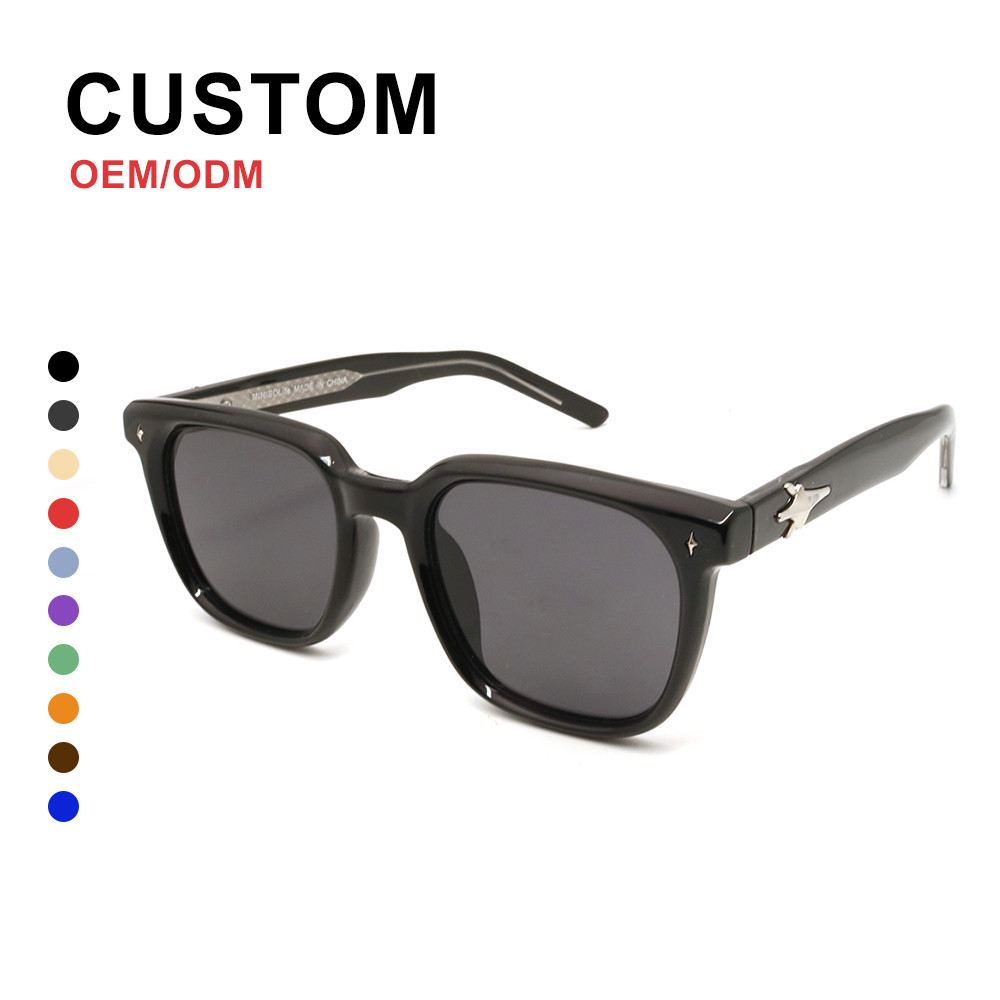
What can the supplier actually make? The range of technical capability varies enormously across eyewear manufacturers. Some factories produce basic stock sunglasses with minimal customization. Others offer full OEM development including frame geometry, hinge mechanics, lens curvature, and material blending[reference:3].
Before requesting a quotation, clarify what level of customization you need:
Model
What It Means
Typical MOQ
Best For
Private Label
Existing frames with your logo and packaging
100–300 pcs
Testing a new market
ODM
Supplier's existing designs, customized with your specs
300–600 pcs
Guided differentiation
OEM
Full custom development from your tech pack and molds
600–1,000+ pcs
Established brands with clear direction
MOQ thresholds vary by material and design complexity. Standard acetate and metal frames typically start around 300 pieces per style, while titanium and specialty constructions may require higher volumes[reference:4]. For a first order, consider consolidating multiple SKUs into a single purchase order with per-SKU minimums to meet the factory's total production floor[reference:5].
Criterion 3: Assess Quality Control and Compliance Readiness
Quality control is where many supplier relationships fail. The factory may produce excellent samples, but bulk production drifts. The solution is a documented QC process and a willingness to share it.
What to Request
In-house vs. outsourced testing: Ask which tests the factory performs in-house and which are sent to third-party labs[reference:6].
AQL standards: Confirm the factory follows an Acceptable Quality Level (AQL) sampling plan. A typical standard for eyewear is AQL 2.5 for major defects.
Compliance documentation: For US-bound products, FDA registration is required. For EU-bound products, CE certification under EN ISO 12312-1 is mandatory. Ask for test reports proving UV400 protection and the relevant lens category[reference:7].
Material safety data sheets (MSDS): Essential for compliance in regulated markets[reference:8].
At READSUN Optical, our quality control system covers the full production chain, from incoming material inspection to final shipment. We maintain CE, FDA, and ISO 9001 certifications and provide full technical documentation with every bulk order.
Criterion 4: Compare MOQ, Pricing, and Tooling Costs
Price negotiation in eyewear sourcing is not about pushing for the lowest number—it is about understanding the cost structure and finding terms that work for both parties.
Key Cost Components
Unit price: Varies by material, lens type, coating, and order volume.
Tooling/mold cost: Required for custom OEM designs. Ask whether the factory will amortize tooling costs across production runs and what the ownership terms are[reference:9].
Sampling fees: Usually credited against the bulk order if you proceed.
Packaging: Custom boxes, pouches, and branding materials add per-unit cost.
Negotiation tactics that work:
Consolidate multiple SKUs into one order to meet the factory's production floor and reduce per-unit costs[reference:10].
Offer a higher MOQ in exchange for lower amortized tooling per pair[reference:11].
Negotiate future price reductions after reaching volume milestones.
Be wary of suppliers offering unsustainably low MOQs (100–300 units) at premium prices. Factories that accept tiny runs typically cut corners on quality or charge unit prices that destroy retail margins[reference:12].
Criterion 5: Evaluate Communication and Responsiveness
Communication speed is one of the most reliable proxies for supplier stability. A factory that responds to your initial inquiry within 24 hours, answers technical questions clearly, and provides structured quotations is more likely to communicate well during production[reference:13].
Test the communication channel before placing an order:
Send a technical question (e.g., "What is the UV400 test standard you use?"). A capable supplier will answer specifically.
Request a sample timeline. Vague answers suggest disorganized operations.
Ask for two or three references from existing B2B customers in your market.
Criterion 6: Understand Payment Terms and Risk Protection
Standard payment terms for a first order with a new supplier are 30% deposit with the balance due against a pre-shipment inspection photo set[reference:14].
Any supplier pushing for 100% upfront payment on an unproven relationship is a red flag. If a factory insists on full prepayment, treat it as a signal to look elsewhere.
Additional protections to negotiate:
Pre-shipment inspection: Arrange a third-party inspection (e.g., SGS, Bureau Veritas) before the balance payment is released.
Written specifications: Always demand a written specification document covering materials, lens type, coatings, and packaging before production begins.
Defective rate clause: Agree in advance on the acceptable defective rate and the remedy (replacement or credit) if it is exceeded.
Criterion 7: Check Certifications and Social Compliance
Certifications serve two purposes: they confirm product compliance for your target market, and they signal that the factory operates to recognized standards.
Certification
What It Covers
Required For
CE
EU product safety compliance (EN ISO 12312-1)
EU market access
FDA
US product safety registration
US market access
ISO 9001
Quality management system
Operational reliability
BSCI / SEDEX
Social compliance and ethical production
Retail chain requirements
RoHS / REACH
Material safety and restricted substances
EU compliance
Verify certificates by checking the certificate number online where possible. Confirm that certificates are issued in the factory's name, not a parent company's or a trading partner's[reference:15].
How READSUN Optical Supports B2B Partners
At READSUN Optical, we have built our B2B operations around the criteria above:
Verified factory operations: Over 20 years of manufacturing experience with full production transparency.
Flexible OEM/ODM/Private Label: We support all three sourcing models with MOQs that accommodate both new brands and established retailers.
Full compliance documentation: CE, FDA, ISO 9001, and RoHS/REACH documentation provided with every order.
Documented QC process: Incoming material inspection, in-process checks, and final AQL-based shipment inspection.
Competitive payment terms: 30% deposit / 70% against pre-shipment inspection for new partners.
Whether you are sourcing your first container of sunglasses or developing a full private-label collection, we can help you evaluate the right model for your market and budget.
Quick Supplier Evaluation Checklist
Factory verification: Live video tour, equipment serial numbers, business registration
Technical capability: OEM/ODM/Private Label options, material range, design support
Quality control: AQL standard, in-house vs. outsourced testing, compliance documentation
Pricing structure: Unit price, tooling cost, MOQ, payment terms
Communication: Response time, technical depth of answers, customer references
Certifications: CE, FDA, ISO 9001, BSCI, RoHS/REACH—verified in the factory's name
Risk protection: Pre-shipment inspection, written specifications, defective rate clause
Conclusion
Choosing a reliable sunglasses supplier is not about finding the lowest price—it is about finding a partner who can deliver consistent quality, meet your compliance requirements, and grow with your business. The seven criteria in this guide provide a framework for evaluating any supplier, whether you are sourcing from China, Taiwan, or elsewhere.
👉 Ready to evaluate READSUN Optical as your next supplier?Contact our B2B team to request factory documentation, sample orders, and a custom quotation for your retail program.

 Aviator
 Cat-eye
 Square
 Oval
 Rectangular
 Round