 Aviator
 Cat-eye
 Square
 Oval
 Rectangular
 Round
Acetate vs Plastic Eyeglass Frames: Which Material Suits Your Brand?
Eyewear Materials and Manufacturing
Two frame lines can leave the same factory, ship in the same box, and still be built on completely different economics. The gap usually comes down to one early decision: sheet acetate or moulded plastic.
The Short Answer
If you are weighing acetate vs plastic eyeglass frames, the split is simple. Cellulose acetate eyeglass frames sell on polish, colour depth and hand-feel. Injection-moulded plastic frames sell on landed cost and weight.
- Both materials start as plastic. Only one of them can be cut, sanded and barrel-polished like a solid block.
- Acetate protects a higher retail price. Moulding protects volume.
- A mismatch does not appear as a cost line. It appears as returns and dead stock.
What Makes Cellulose Acetate Eyeglass Frames Different
Cellulose acetate begins as a sheet, not as a pellet. Cotton fibre and wood pulp are treated, blended with plasticiser and pressed into blocks or sheets. The front is then cut out of that sheet, so the colour runs through the material instead of sitting on top of it.
Cut and polished, not poured
Because the front is machined from solid sheet, edges can be bevelled, layered and polished back to a glass-like surface. That is where the depth comes from. A moulded frame leaves a steel tool with the surface the tool gave it, and nothing more.

Heat adjustment stays in the optical shop
Acetate softens under controlled heat. Temples can be bent, pad arms re-angled and a frame re-fitted on the spot, which is why acetate takes adjustments a moulded frame cannot. Once a moulded frame cools, its geometry is fixed by the tool.
The trade-offs are real
Sheet acetate costs more per frame, takes longer because of the tumbling and polishing stages, and adds weight on the face. It also depends on a maker who understands the material: cutting speed and polishing time decide whether the frame reads as premium or slightly cloudy. The precision moulding route is cheaper to run, but it will not produce that surface.
Acetate Eyeglass Frames vs Metal
Metal and acetate are not really competitors. They solve different problems. Metal is thinner, so rimless and semi-rimless designs keep a low visual weight. Acetate gives you volume, colour, and a front that can carry a logo in relief.
| Material | Best for | Watch out for |
|---|---|---|
| Sheet cellulose acetate | Colour depth, polish, premium hand-feel | Weight, production time, cost per frame |
| Injection-moulded plastic | Low unit cost, light weight, high volume | Limited finish, shape fixed after cooling |
| Metal | Slim rims, rimless, technical look | Adjustment limits, plating wear |
| Magnesium aluminium | Very light metal frames | Narrower colour range, separate finishing line |
Magnesium Aluminum Sunglasses Frame vs Acetate
A magnesium aluminum sunglasses frame is chosen for weight, not for colour. The alloy keeps a sunglasses front light enough for all-day wear and suits wrap and sport shapes where acetate would add bulk. Acetate wins when the silhouette is the design: a thick square, a chunky keyhole bridge, a two-layer lamination.
The practical test is the sample wall. Put both under retail lighting. If the metal version reads thin and technical while the acetate version reads solid and warm, the assortment is doing its job.
Cellulose Acetate Propionate: The Middle Path
Cellulose acetate propionate, usually shortened to CAP, is a cellulose ester related to acetate but processed differently. It can be injection moulded or extruded, so a part can come out of a tool instead of being cut from a sheet.
Where propionate earns its place
It keeps a cellulose-based story, holds colour well and tolerates moulded production. That makes it useful for volume programs and for parts such as temples and inner rims. Many production frames combine the two: an acetate front with moulded temples.
Where it does not
Propionate will not give you the deep polish of a barrel-finished acetate sheet, and it does not carry lamination the same way. If the design depends on a visible layered edge or a tortoise pattern that runs through the thickness, extruded material will not deliver it.
Sunglasses Acetate Frames vs Plastic Frames
Sunglasses make the difference obvious, because the frame is a much larger share of what the customer sees. A sunglasses acetate frame can be built thick, laminated in two colours, and polished until the edge reads as a solid block of material. A moulded plastic sunglasses frame can match the outline at a lower price, but the surface stays flat and the colour stays uniform.

What to check on a sample
- Thickness consistency across the front and along the temples.
- Whether the pattern continues through the hinge area instead of stopping at it.
- Edge polish. Sharp reflections mean real finishing time; dull edges mean a short cycle.
- Hinge quality, which decides how the frame feels long after the polish has dulled.
How to Match Material to Your Frame Line
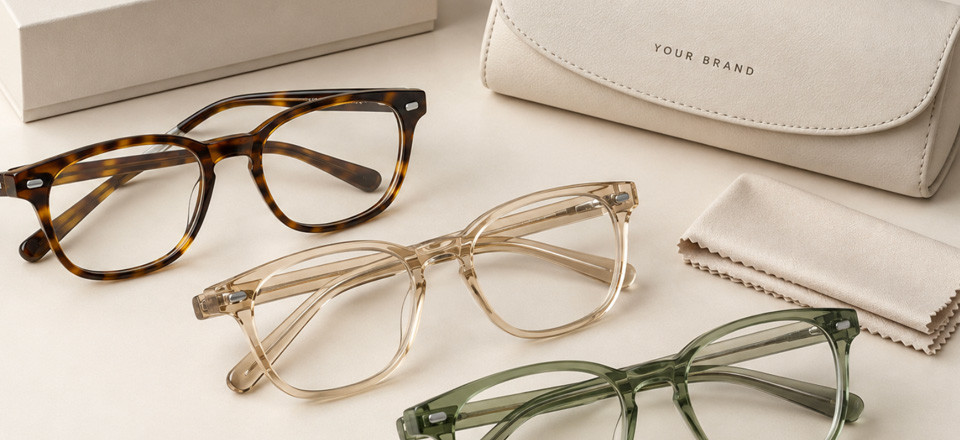
Premium and fashion line
Go with sheet acetate. Colour, lamination and polish are the product, and they justify the ticket.
Volume and entry price
Go with injection moulding. Predictable cost, light weight, fast repeat orders.
Hybrid build
Acetate front, moulded temples. Keep the look where the customer looks, save cost where they do not.
The production partner matters as much as the material. Our acetate optical frames line is built around sheet material, the background sits on the material page, and the manufacturing process shows how cutting, tumbling and polishing are sequenced.
Common questions
Is acetate stronger than plastic?
Not in impact terms. Moulded plastics such as polycarbonate take impact better. The acetate advantage is finish, colour depth and heat adjustment.
Can acetate frames be recycled?
Acetate is a cellulose-based thermoplastic, so cutting offcuts can be reground and reused in some applications. Ask your supplier what happens to sheet waste before making a recycled-content claim.
Which material should a first collection use?
Start from the price band you want to defend. If the frame has to look expensive on a shelf, use sheet acetate. If it has to hit a landed cost, use moulding.
The material decision is a positioning decision. Choose the surface the customer will touch, then let the process follow it.